The Project
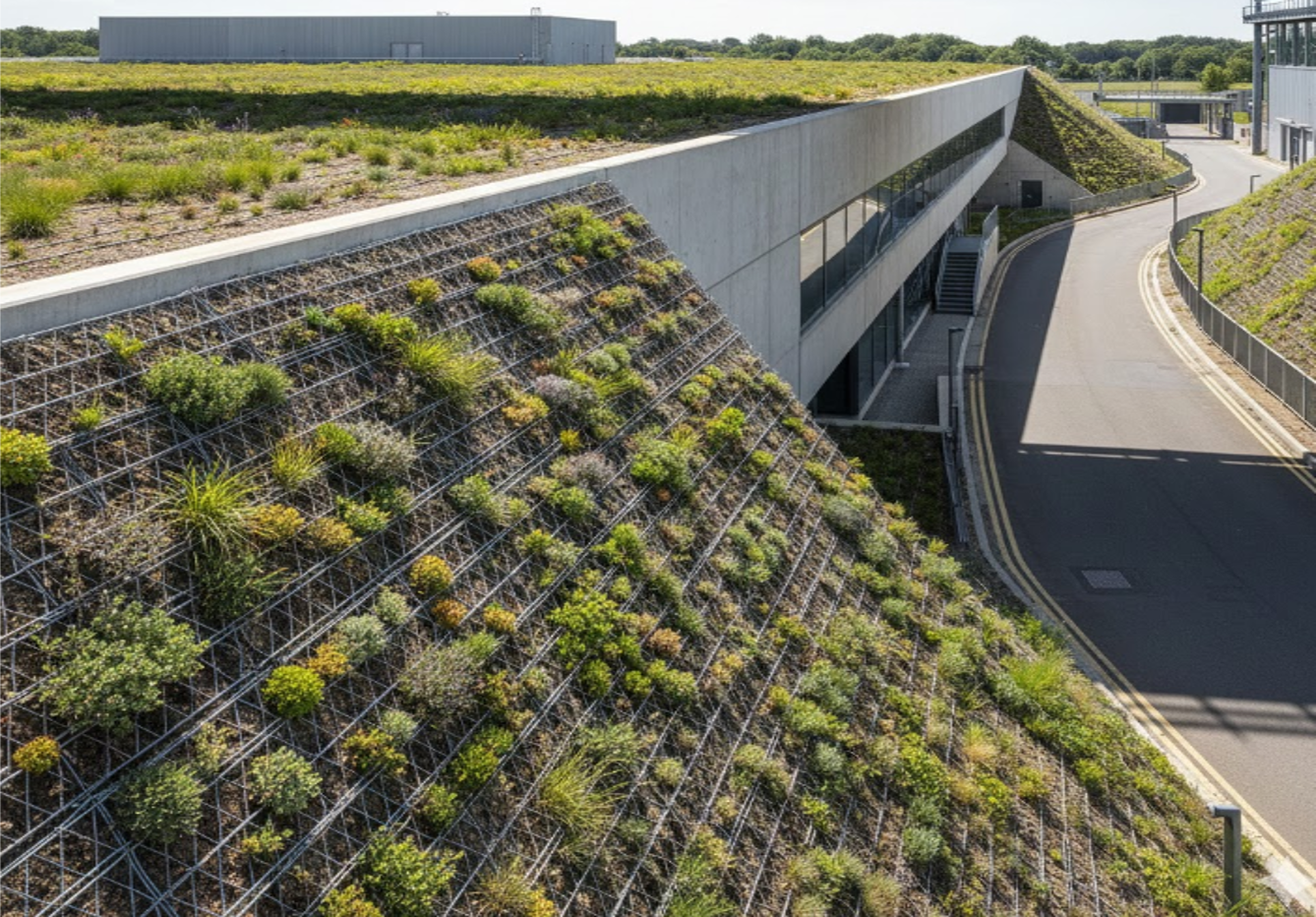
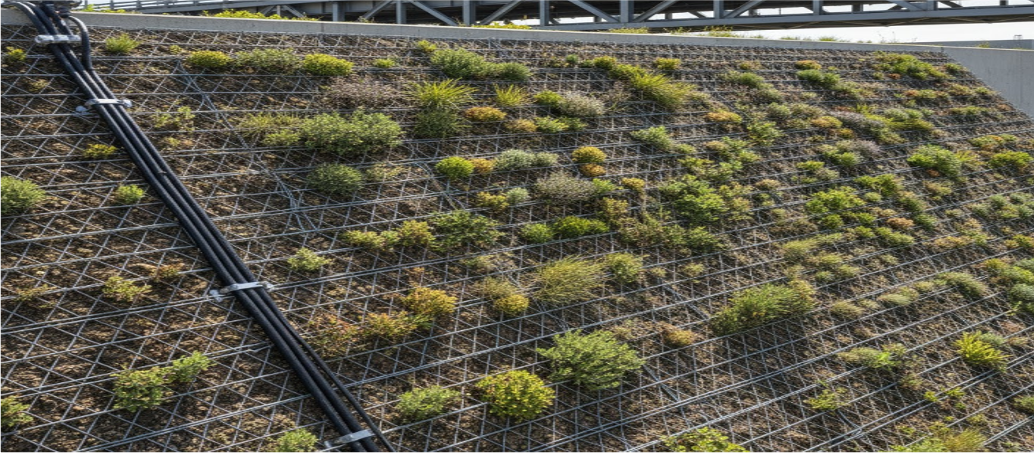
The Fusion Demonstration Plant at Culham Science Centre is a highly serviced, technically complex site. The sloped green wall runs alongside a service road beneath a bridge structure, forming a prominent green edge to the approach while sitting within a tight corridor for services and access. The reinforced slope is constructed using a Terramesh system, with a wire mesh face and a relatively thin vegetated topsoil layer as the planting medium.
The geometry of the wall, with a 65–70° incline, means gravity strongly influences water movement. Any surface irrigation or poorly planned drip layout would tend to drive water downwards quickly, leaving upper portions dry and increasing the risk of erosion in the lower third.
Above, the Level 01 roof supports approximately 1,700 m² of green roof planting, largely mixed shrubs in shallow, lightweight substrate. Both the roof and the slope are exposed to wind and sun, and both have limited soil depth, which constrains the available water storage within the profile. The irrigation design therefore needed to finely control application rates and distribution while working within the architectural and structural constraints of the building.
Our approach and thinking
We approached the sloped green wall as a combined geotechnical and horticultural problem. The priority was to maintain the integrity of the Terramesh and soil system while providing enough moisture for planting. That ruled out overhead or spray irrigation, which would risk surface scour and uneven wetting patterns. Drip irrigation embedded in the vegetated layer, controlled from the top of the slope, offered a way to deliver water into the root zone without disturbing the face.
Understanding how water would move through the profile, we considered the slope in vertical thirds. The upper two-thirds were likely to drain quickly and dry out faster, while the lower third would receive both direct irrigation and water migrating downslope. This informed our approach to dripline spacing and zoning.
Access and maintainability were another key consideration. Control valves and manifold arrangements had to be reachable for commissioning and servicing, but could not obstruct the service road or conflict with the bridge structure. Concentrating primary control at the crest of the slope, with distribution running downwards, gave a logical and maintainable layout.
For the Level 01 green roof, our thinking focused on aligning irrigation strategy with substrate depth and planting mix. We favoured dripline and point-source irrigation that could be zoned by orientation and planting type, allowing the facilities team to adjust schedules as the planting establishes and the building’s operational pattern becomes clearer.
The Irrigation Solution
Sloped green wall design
The sloped green wall is irrigated using dripline laid on the vegetated topsoil layer over the Terramesh system. In line with the structural geometry, driplines are laid horizontally along the length of the slope, following contour lines. This orientation limits the tendency for water to track rapidly downslope, promotes even distribution along each band and reduces the risk of localised erosion.
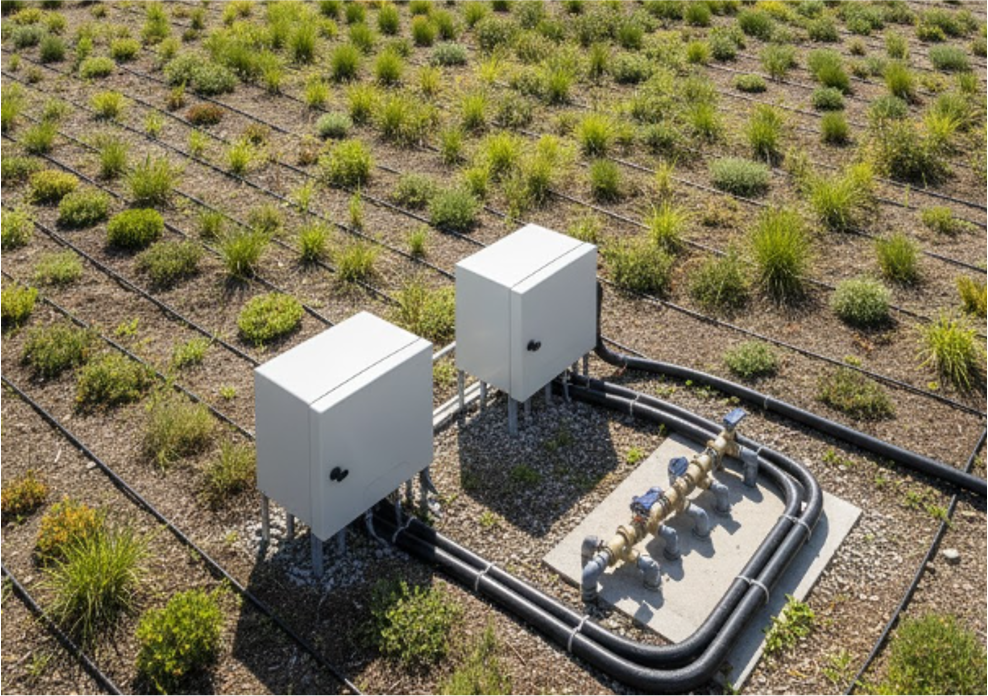
At the crest of the wall, a series of control valves is located in accessible positions behind the top of the slope. From these valves, lateral pipes run along the top edge, feeding QF dripline header pipes that are set out vertically down the face of the slope. The vertical headers function as supply spines, from which the horizontal driplines are connected at regular intervals, creating a grid that ensures consistent coverage across the entire surface.
To reflect the different water dynamics along the slope, dripline spacing is varied. In the upper two-thirds, where water drains more quickly, lateral spacing is reduced to provide more frequent lines and hence higher application density. In the lower third, where water naturally accumulates, spacing is increased slightly to avoid over-watering and to match the expected higher moisture availability.
This strategy balances plant health and water efficiency while respecting the constraints of the Terramesh system and thin soil layer.
Hydraulics, zoning and control
The green wall irrigation is divided into zones based on orientation, exposure and reach of the distribution network. Zoning allows for staggered operation, moderating peak flow demands on the pump set and enabling fine-tuning if certain sections dry out faster than others.
All valves are located at the top of the slope, reducing the amount of control infrastructure on the face and simplifying access for maintenance. The pumproom design and mainline sizing were coordinated with Fabrik and the wider design team to integrate cleanly with building and bridge services routes, while providing sufficient capacity for both the green wall and the Level 01 roof.
Level 01 green roof irrigation
The Level 01 green roof, with approximately 1,700 m² of planting, is irrigated via dripline and / or point-source emitters laid within the shallow substrate. Zones are set up to reflect aspect, wind exposure and planting character, so that more exposed or moisture-demanding areas can receive slightly different schedules to more sheltered parts of the roof.
The roof irrigation connects back to the same primary infrastructure, sharing pumproom and control strategy but operating on its own set of zones. This keeps the overall system coherent while acknowledging the different performance requirements of the slope and the roof.
Buildability and maintenance
Throughout the design, we aimed for details that contractors could build straightforwardly and that FM teams could understand. Dripline layout is regular and documented, valve locations are consolidated where possible, and headers and laterals are arranged to avoid clashes with anchors, drainage elements and other services.
By keeping most control and manifold elements off the slope face and out of roof high-traffic zones, the system can be inspected, flushed and adjusted without disruptive access arrangements.
Results and Value
Stable irrigation for a steep green wall
The drip-based layout integrated with the Terramesh system provides water directly into the vegetated layer without causing surface runoff or undermining the structural face.
Targeted water use across the slope
Adjusted dripline spacing in the upper and lower parts of the wall reflects real water movement, improving plant performance while avoiding unnecessary irrigation in naturally wetter zones.
Clear, maintainable infrastructure
Locating valves and manifolds at the crest and rationalising pipe runs gives maintenance teams straightforward access for inspection, flushing and adjustment.
Integrated solution for wall and roof
A single pumproom and coherent control strategy serve both the sloped wall and the Level 01 green roof, simplifying operation and long-term management.
Support for design intent and programme
A coordinated irrigation design allowed Fabrik and the project team to progress detailed design and construction planning with a clear understanding of space, load and access requirements.